Cyber risks, provider-neutral controls, evidence questions.
Each cyber risk is reduced by controls that state what should be true, independent of any vendor. Each control is broken into evidence components: the specific questions collected evidence must answer. Controls are evaluated once and reused across every risk they reduce.
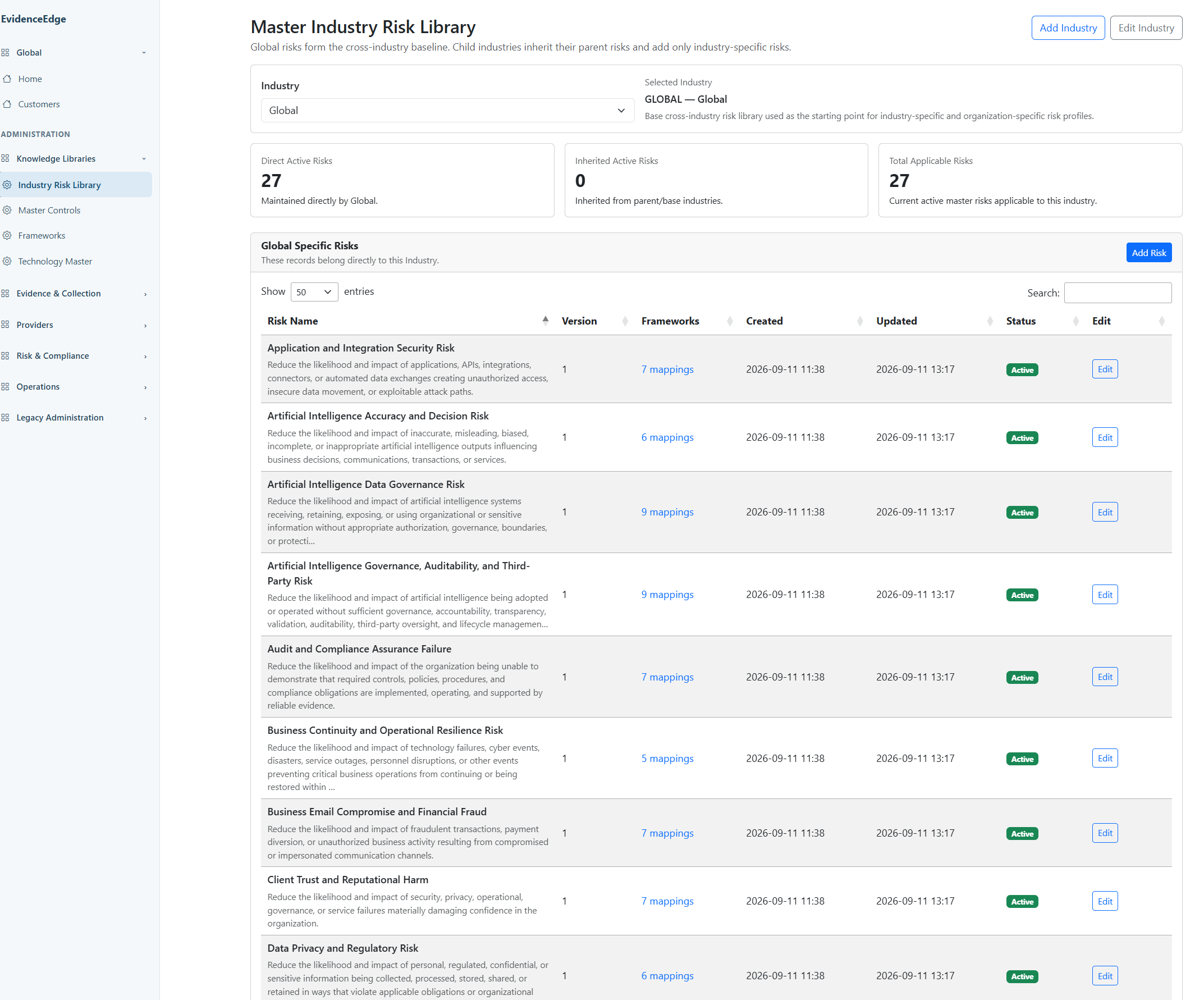
The library is organized by industry. The Global library holds 27 cross-industry risks; Financial Services inherits them and adds Regulation S-P and Regulation S-ID. An organization's Risk Register is a point-in-time snapshot of its industry library, tailored to the organization.
| Demo Organization register | Count |
|---|---|
| Cyber risks | 29 |
| Controls | 39 |
| Evidence components | 132 |
| Control-to-risk mappings | 177 |
The same twelve steps, every assessment.
The audit steps are quality gates: results move forward only after their lineage and methodology are checked.
| Stage | Step | What happens |
|---|---|---|
| Readiness | 1. Validate Register | Risks, controls, components, decision tables, bindings and framework mappings are complete. |
| 2. Collection Readiness | Every required capability has a valid binding and its prerequisites. | |
| 3. Runtime Preflight | Live app-only access to each source is verified. | |
| Evidence | 4. Evidence Collection | One job per required capability. Evidence is immutable, with full provenance. |
| 5. Component Readiness | Each evidence question has its rules, bindings and evidence in place. | |
| Components | 6. Evaluate Components | Every evidence question answered: deterministic, hybrid or AI-assisted. |
| 7. Audit Components | Deterministic check of lineage, required facts and methodology. | |
| Controls | 8. Evaluate Controls | Each control decided once by its decision table. |
| 9. Audit Controls | Each control used the intended component results. | |
| Risk Intelligence | 10. Risk Intelligence | A posture with cited findings and priorities for every cyber risk. |
| 11. Organizational Risk Advisor | “Am I covered?” from all completed risk assessments. | |
| 12. Organizational Risk Audit | The detailed, evidence-linked audit and its PDF. |
Available now Once readiness is confirmed, an autonomous run performs steps 4, 6, 8, 10, 11 and 12 end to end: about 12 minutes for the Demo Organization register.
Rules and evidence first. AI where it helps.
Evidence collection is separate from evaluation. Deterministic rules decide first, and AI is used as one bounded reasoning step, not as the system itself. Missing evidence is reported as uncertainty, never as a confirmed failure.
Evidence component
Does the evidence answer the question?
Satisfied Partial Failed UnknownControl
Is the safeguard working? Each control has a decision table; the first matching row wins.
OK Partial Gap ReviewCyber risk
How protected is the business, weighing every control that reduces the risk?
Protected Partially protected Exposed Insufficient evidenceA control GAP is not automatically an exposure: the risk posture weighs it against every other control that reduces the same risk, and distinguishes a real weakness from an evidence limitation. Explore the relationships.
Control states: what each level of protection requires
Every control in the register has four state definitions, each with criteria specific to that control. Strong Authentication and MFA, from the Demo Organization register:
| State | What must be true |
|---|---|
| OK | MFA and strong authentication are materially enforced for applicable users, especially privileged users, with no material bypass. |
| Partial | MFA is present but coverage, method strength, privileged protection, registration, exclusions, or bypass prevention is incomplete. |
| Gap | MFA is absent, materially ineffective, or bypassable for a material population. |
| Review | Enforcement scope, authentication methods, privileged coverage, exclusions, or bypass evidence is insufficient or contradictory. |
Six evidence questions decide it
| Evidence question | Materiality |
|---|---|
| Is MFA materially enforced for the applicable identity population, rather than merely available or registered? | Critical |
| Are privileged identities consistently protected by strong MFA or stronger authentication requirements? | Critical |
| Are strong or phishing-resistant authentication methods available and required where risk warrants them? | Material |
| Do registration, bootstrap and recovery mechanisms support secure adoption without materially weakening the control? | Material |
| Do exclusions or alternate access paths create a material bypass around strong authentication requirements? | Critical |
| Can legacy or basic authentication materially bypass MFA or modern authentication controls? | Critical |
The control's decision table
| Priority | Rule | State |
|---|---|---|
| 10 | Any required question Unknown | Review |
| 20 | Any required question Failed | Gap |
| 30 | Any required question Partial | Partial |
| 40 | All required questions Satisfied | OK |
Rows are checked in priority order and the first match wins. Each result records the table version, the matched row and the component results used, so it can be explained and replayed.
Each question is answered against written criteria for Satisfied, Partial, Failed and Unknown, with the facts it requires. A disabled policy is evidence of a configuration problem (Failed); a policy that cannot be retrieved is an evidence problem (Unknown), and the two are never treated alike. State definitions and rules are held in the register, so the methodology can be tailored to an organization while staying consistent within each assessment.
Interfaces, capabilities and operations.
The interface is how EvidenceEdge connects, the capability is what evidence it gets, and the operations are the exact calls it makes. One capability result can feed many evidence components, so it is collected once per run.
| Interface | How it connects | Capabilities | Operations | Status |
|---|---|---|---|---|
| Microsoft Graph | Graph REST API, app-only | 65 | 69 | Available now |
| Microsoft Exchange Online | Exchange Online PowerShell | 18 | 18 | Available now |
| Microsoft Security & Compliance / Purview | Purview PowerShell | 12 | 12 | Available now |
| Microsoft SharePoint Online | SharePoint Online PowerShell | 1 | 1 | Available now |
| Microsoft Defender for Endpoint | REST API, app-only | 1 | 1 | Available now |
| SentinelOne | REST API, API token | 5 | 5 | In development |
| Total | 102 | 106 |
The catalog is everything EvidenceEdge can collect; an assessment runs only what its register needs. CrowdStrike, AWS and Google Cloud are In development. Sources that cannot be reached are covered by provider- or management-supplied evidence Supplied.
Collection rules are separate from decision rules
Collection rules determine what evidence is obtained and how. Decision rules determine what that evidence demonstrates. Keeping them apart means a source can change without changing what the control requires.
| Configuration layer | What it defines |
|---|---|
| Collection interface | The provider and access mechanism, such as Microsoft Graph or Exchange Online. |
| Collection capability | A reusable dataset EvidenceEdge knows how to obtain, such as Entra Conditional Access policies. |
| Collection operation | The executable API call or PowerShell command behind a capability. |
| Evidence source binding | Which capabilities may answer a specific evidence question, and in what role: primary, supplemental or alternate. |
| Aggregation rule | How evidence from several sources is combined: Combined Evidence, All Applicable, or Any Satisfies. |
In the Demo Organization register, 132 evidence questions carry 276 source bindings, and 94 of the 132 can be answered by more than one source. The same evidence can support many questions, and the same question can have more than one acceptable source.
Not a one-time scan.
Ongoing Monitoring reruns the complete assessment and compares it with the previous cycle across evidence, controls and cyber risks, so each change is shown as an improvement, a downgrade or unchanged, and traced to the evidence behind it.
Available now Full assessment on demand Planned Scheduled monthly runs, history and trend reporting
Seven layers, one provider-neutral model.
From who is in scope, through industry-based master knowledge, the organization and its point-in-time register, to evidence collection, evaluation and Risk Intelligence, and the platform that automates it end to end on Microsoft Azure.
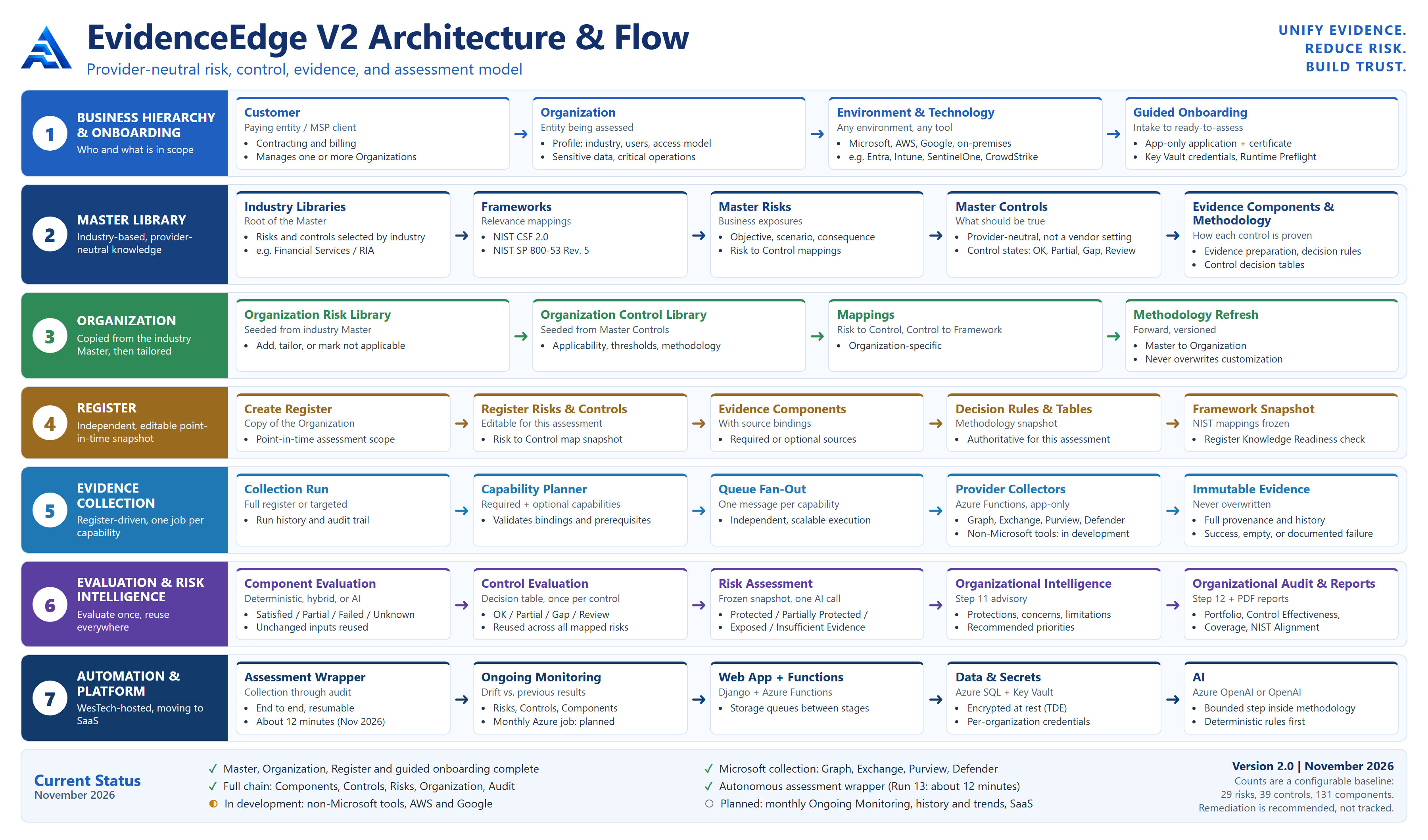
EvidenceEdge V2 Architecture & Flow, Version 2.0, November 2026.
Hosted and operated by WesTech in Azure.
Least-privilege access
A dedicated application per organization with only the access it needs, authorized by the organization's administrator. No agents, no shared passwords.
Credentials in Key Vault
Each organization's application certificate is held in Azure Key Vault.
Encrypted
Evidence and results in Azure SQL with Transparent Data Encryption; encrypted in transit.
Immutable evidence
Collected evidence is kept with full provenance, so every conclusion can be traced back to its source.