EvidenceEdge · Cybersecurity Oversight & Assurance

Know your risk. Prove your oversight.

Your organization invests in cybersecurity. But can you demonstrate that your protections are working?

EvidenceEdge transforms cybersecurity evidence into clear, actionable business intelligence, helping organizations evaluate existing security controls, understand their risks, and demonstrate responsible oversight.

Whether your technology is managed internally or by outside providers, EvidenceEdge bridges the gap between what you believe is protecting your organization and what the evidence actually shows.

Know what's working. Identify what isn't. Document what you're doing about it.
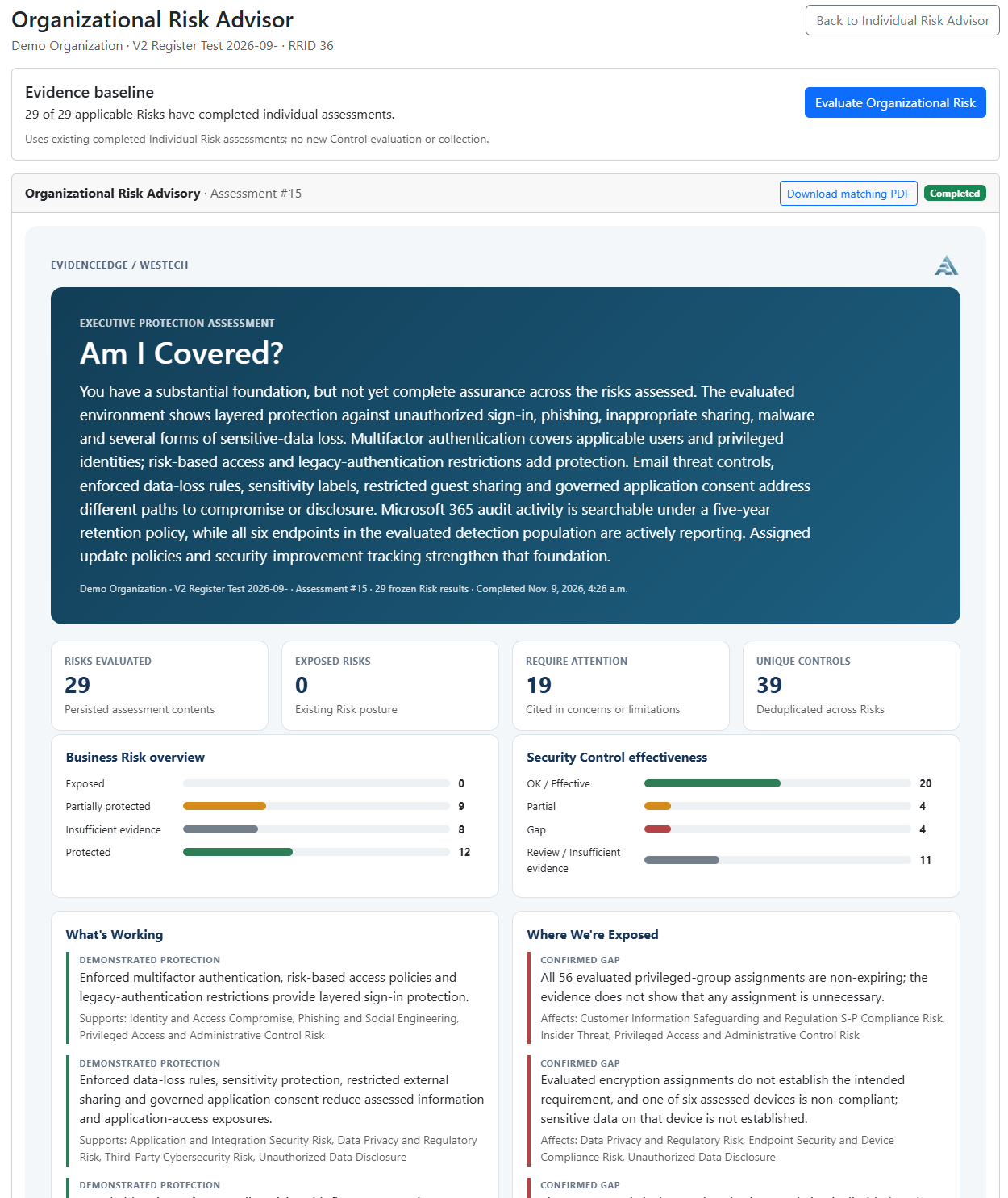
EvidenceEdge Organizational Risk Advisor answering Am I covered for the demo organization

Organizational Risk Advisor: “Am I covered?” answered for the demo organization.
We don't just check your security settings. We determine what they prove.

EvidenceEdge doesn't just ask whether a control exists. It defines what acceptable protection looks like, what evidence is required to prove it, and how that evidence determines whether the protection is actually satisfied.

  1. 01What protection is required?The control objective
  2. 02What conditions must be true?Control states
  3. 03What evidence establishes them?Evidence requirements and collection rules
  4. 04What does the evidence demonstrate?Decision rules
  5. 05What effectiveness is supported?The control conclusion, with its reasons
1 · Control states

What effective protection actually means

Every control has four defined states, each with written criteria: OK Partial Gap Review. The state describes the protection the evidence demonstrates, not whether a product feature is present.

2 · Evidence requirements and collection rules

What must be shown, and from where

Each control is broken into evidence questions. Each question names its acceptable sources (primary, supplemental or alternate) and how evidence from several sources is combined. Collection rules decide what evidence is obtained and how.

3 · Decision rules

What the evidence demonstrates

Each question is answered Satisfied, Partial, Failed or Unknown against written criteria. Each control's decision table then selects its state, in priority order. Decision rules decide what the collected evidence demonstrates.

A real evaluation · Demo Organization

Unmanaged Device Data Access Protection

Required for OK: sensitive data is materially prevented from being downloaded, synchronized, copied or persisted on unmanaged devices.

Control conclusionPartial
Evidence questionAcceptable sourcesWhat the evidence showedConclusion
Do access policies materially restrict sensitive data access from unmanaged or untrusted devices? Entra Conditional Access (primary) Multiple current policies enforce the restriction. Satisfied
Are download, sync and local-storage controls configured to prevent or materially restrict data persisting on unmanaged devices? SharePoint tenant settings (primary), Entra Conditional Access (supplemental) SharePoint does not restrict unmanaged sync; Conditional Access provides some compensating protection. Partial
Decision table
  1. Any question Unknown → Review
  2. Any question Failed → Gap
  3. Any question Partial → Partial matched
  4. All questions Satisfied → OK

Why Partial: protections exist, but some apps, users, platforms, data or access paths still permit inappropriate local persistence. The decision rule also states that a disabled SharePoint setting alone does not establish a failure when Conditional Access effectively blocks the unmanaged path, so the methodology weighs compensating protection instead of reacting to a single setting.

Missing protection

A disabled policy is evidence of a configuration problem. The question is Failed and the control is a Gap.

Missing evidence

A policy that cannot be retrieved is an evidence problem. The question is Unknown and the control goes to Review. It is never counted as a failure.

EvidenceEdge can explain not only that a control is partially effective, but which requirements were satisfied, which were not, what evidence supports each, and why the resulting state was selected. See the full methodology.

Evaluate. Understand. Act. Demonstrate.

01

Evaluate

Assess the safeguards already in your technology environment.

02 · RISK INTELLIGENCE

Understand

Translate cybersecurity controls into Risk Intelligence that demonstrates how each cyber risk is being managed.

03

Act

Prioritize weaknesses, then see each change as an improvement, a downgrade or unchanged.

04

Demonstrate

Maintain evidence-supported documentation of cybersecurity oversight.

Cyber risk intelligence, backed by evidence.

The headline outcome

Cyber risk intelligence

Every weakness connected to the cyber risks it affects, weighed against the controls that are working, and explained in plain language with clear priorities.

See it in the interactive demo →
Leadership sees not a list of settings, but how protected the business actually is, and why.Evidence · Control effectiveness · Cyber risk

Independent visibility

A view of your protections that does not depend on who manages them.

Evidence-supported evaluation

Safeguards judged on collected and documented evidence, not on statements that a control exists.

Accountability

Each cycle shows what changed since the last: improvement, downgrade or unchanged.

Documented oversight

A structured record of assessments, findings and management responses for leadership, compliance and audit discussions.

Onboard once. Assess. Monitor. Report.

Want the detail? The 12-step assessment is in the Technical overview.

Controls state what should be true, whatever tools you use.

Change a tool and the controls stay the same; only the evidence source changes. Where a source cannot be reached automatically, evidence can be supplied by your provider or by management, and is labeled that way.

Evidence sourceStatus
Microsoft 365, Entra ID, Exchange Online, SharePointAvailable now
Microsoft Defender for Endpoint and Microsoft PurviewAvailable now
Provider- and management-supplied evidenceSupplied
SentinelOneIn development
CrowdStrike, AWS and Google CloudIn development

Reports for leadership, compliance and your providers.

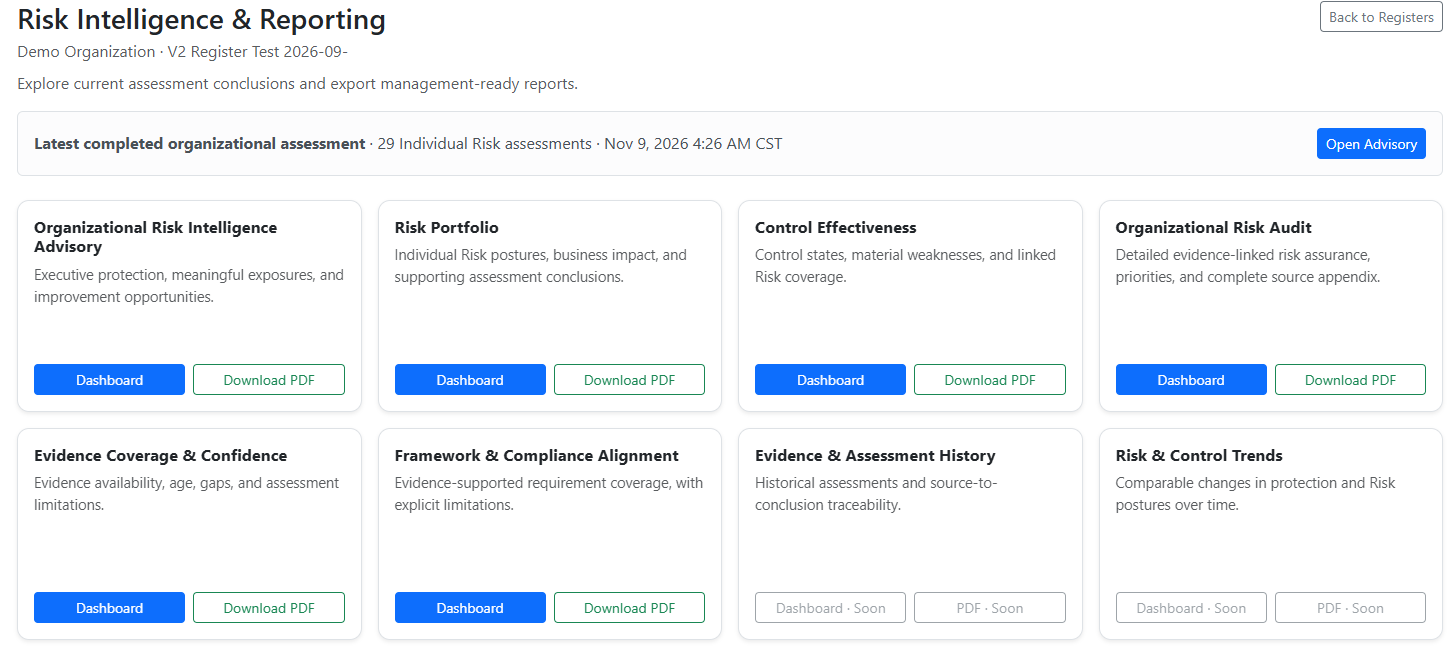
  • Organizational Risk Intelligence Advisory: are we covered, and what comes first
  • Organizational Risk Audit: detailed, evidence-linked assurance
  • Risk Portfolio
  • Control Effectiveness
  • Evidence Coverage & Confidence
  • Framework & Compliance Alignment (NIST CSF 2.0, SP 800-53)

Every report is an interactive dashboard and a PDF. A framework mapping shows relevance, not a compliance determination.

EvidenceEdge report library for the demo organization

Report library, shown on the EvidenceEdge demo organization.

What makes EvidenceEdge different

  • 1

    Evaluate what you already own

    Assess security capabilities and configurations within existing technology investments rather than making additional product purchases the default answer.

  • 2

    Evidence over assumptions

    Use available technical and documented evidence to assess safeguards rather than relying exclusively on questionnaires or statements that a control is implemented.

  • 3

    Translate controls into Risk Intelligence

    Demonstrate how each cyber risk is being managed by connecting the effectiveness of every control to the risks that matter to management, so leadership understands the significance of security findings.

  • 4

    Turn findings into measurable change

    Prioritize weaknesses, then let ongoing monitoring serve as a change control record: each cycle identifies every change as an improvement, a downgrade or unchanged.

  • 5

    Demonstrate oversight

    Present a structured, evidence-supported record of assessments, findings, and management responses for leadership, compliance, and audit discussions.

Your evidence, protected by design.

Evidence that speaks to what regulators ask about.

For financial services, the risk library includes the themes registered investment advisers are examined on.

EvidenceEdge supports your compliance program. It does not provide legal opinions or certify compliance.

Cybersecurity protection is essential. Cybersecurity oversight is your responsibility.

EvidenceEdge helps organizations independently evaluate their existing cybersecurity protections, identify and prioritize risks, and document the evidence behind management's oversight decisions.

EvidenceEdge
The confidence to know. The evidence to show.